

Operations Hub for an Aerospace Flammability Testing Laboratory
Timeline
10 months, ongoing
Team
5 team members
Platforms unified — QuickBooks, Asana and Google Drive behind one interface
Auto task-sync interval
Manual folder setups
Project overview
ErgoServ built a centralized internal operations hub for an independent aerospace flammability testing laboratory in the US — connecting QuickBooks, Asana, and Google Drive into one system that enforces pre-payment, gates deliverables until invoices are settled, and replaces manual file handling with automation.
The situation
The lab tests aircraft materials for flammability compliance, running four distinct billing arrangements across a small team. QuickBooks tracked invoices, Asana tracked tasks, and Google Drive held the files — but nothing connected them, so nothing enforced that work began only after payment cleared or that a certified report shipped only once an invoice was settled. Every new job also meant manually building a folder structure by hand, a process that scaled with headcount the lab didn't have.
Every job lived in three different places at once, with nobody able to see the whole picture without checking all three. Nothing stopped a certified test report from reaching a client whose invoice hadn't been paid.
Main challenges
Three sources of truth, no single view
Billing status lived in QuickBooks, task progress in Asana, and files in Drive, with no dashboard connecting them. Checking on one job meant opening three tools and reconciling the picture by hand.
Deliverables could ship before payment cleared
No system prevented a certified test report from reaching a client whose invoice wasn't settled. The safeguard was informal — a staff member remembering to check QuickBooks first.
Manual file handling was a daily tax
Every new job required building its Drive folder from scratch, then manually moving approved deliverables into place — often duplicating files that already existed elsewhere.
How ErgoServ approached it
We started with a business systems audit — mapping all four billing models end to end and tracing exactly what happened to a file between creation and client delivery. The risk needed to be closed at the architecture level, not through better procedures: QuickBooks was fixed as the single source of truth for money, and the Aeroblaze hub was built to orchestrate the job workflow around it, unlocking deliverables only when QuickBooks confirmed the invoice was paid.
What was built
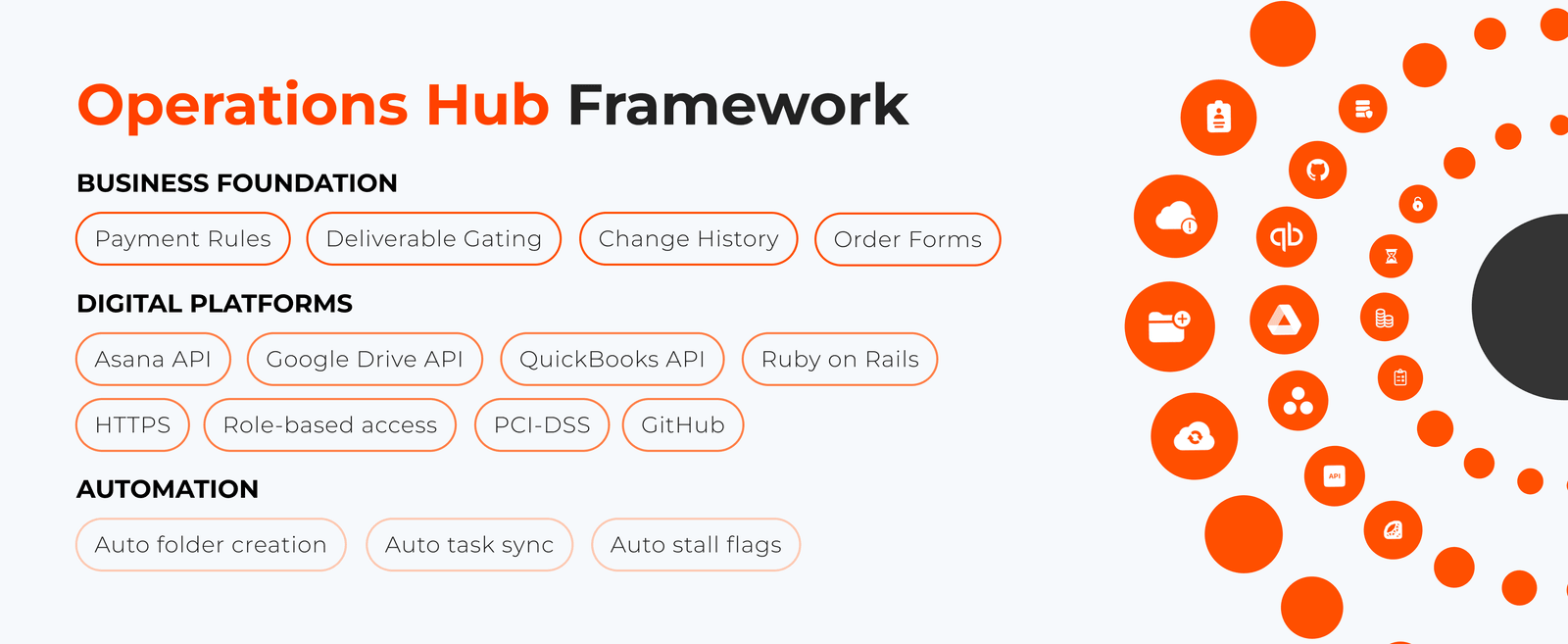
Ten workstreams across three Quad-Core layers.
Business processes
Mandatory pre-payment enforcement
Net-terms intervals (15/30/60/90 days) auto-calculate due dates.
Deliverable gating
Certificates and reports stay locked until QuickBooks marks the invoice paid.
Digital order and test-result forms
Dynamic fields replace manual submission and generate PDFs automatically.
Append-only change history
Job-level, color-coded and append-only, with full staff attribution.
Digital platforms
Centralised operations hub
One interface for job status, tasks, billing, and documents.
QuickBooks Online integration
Orchestrates the full billing lifecycle while remaining the sole system of record for money.
Native task module
Full CRUD; three default tasks are created automatically the moment a job is initialised.
Automation
Auto folder creation
A least-privilege Google Drive service account creates every job folder and pulls in only approved files — no manual setup, no duplicate uploads.
Auto task sync
One-way Asana sync every 15 minutes, scoring completion, overdue status, and dependency impact with no manual updates.
Auto stall flags
A job is flagged urgent past 7 days unstarted, flagged again under 50% progress at 14 days, and marked inactive after 7 idle days.
Aeroblaze system architecture
QuickBooks holds the money, the hub holds the workflow, Asana and Drive follow.
Outcomes
Business outcomes
- Work never starts, and a report never ships, ahead of payment — the system enforces it, not staff memory.
- Every job folder is created and populated with zero manual setup and zero duplicate uploads.
- Stalling jobs surface automatically at 7 and 14 days, instead of only once a deadline slips.
- Every job change is logged, color-coded, and attributable to a person and timestamp.
Technical outcomes
- QuickBooks Online API integrated across the billing lifecycle while remaining PCI-DSS compliant — no card data rendered or stored internally.
- Asana API sync with completion aggregation, overdue detection, and dependency scoring on a 15-minute schedule.
- Role-based permissions enforced over HTTPS, with document access controlled at the architecture level.
Technologies
We use the most effective stack of technologies tailored to every individual project.
Backend
- Ruby on Rails
- RESTful API
Integrations
- QuickBooks Online API
- Asana API
- Google Drive API
Security
- PCI-DSS compliant
- HTTPS
- Role-based, least-privilege access
Infrastructure
- Heroku
- GitHub
Three disconnected platforms became one connected system — the business gets paid before it delivers, automatically.
We don't just build software — we organize how your business works.
Other projects
See more of our work.
Roommate Finder Social Platform
Scaling a co-living marketplace from founder MVP to a matching engine serving multiple metro areas.
Read the full story
CRM for Real Estate Brokers
Contract management, automated reviews and transaction compliance for real estate businesses.
Read the full story